


 |
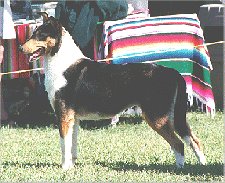
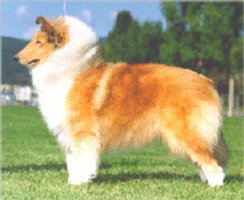 WHAT COLORS DO THEY COME IN?Many people don't realize, but Collies come in SIX different colors. The one most people associate with a Collie is SABLE AND WHITE, which was the color of Lassie. Sables can range from lemon-golden brown to a dark, rich mahogany tinged with black. TRICOLORS are very striking, as they have a black body color, white collars and white legs, with tan markings about the face. BLUE MERLES are less frequently seen, but their bodies are a silver blue/grey with some small black patches, with again the white collar, white legs and tan markings. SABLE MERLES are often mistaken for Sables as they look almost identical when adults. A sable merle has the sable body color, with small patches of "merling" throughout the head and body and these patches fade as the dog matures. Generally these dogs are light golden sables and can occasionally have one or two blue eyes. They also have the white markings around the collar, legs and tip of the tail. WHITE COLLIES are the rarest of all the colors. These animals have white bodies with colored heads and patches, and the heads can be blue, sable, tri or sable merle. White collies are NOT defective in any way. The last color is DOUBLE MERLE, and dogs of this color can not be shown. Double merles occur when breeding two merles together and are generally all white with some grey markings on the head and ears. Double merles usually lack pigment and are often defective. Deafness, blindness or lack of eyes often occur. A double merle that can see and hear makes a great and distinctive pet.HOW BIG ARE COLLIES?Collie are a medium sized dog, ranging from 22" to 24" (females) and 24" to 26" (males) at maturity. Most Collies will weigh between 55 and 80 pounds.DO THEY REQUIRE A LOT OF BRUSHING?Yes for Roughs and no for Smooths. A Rough Collie should be brushed once a week and it will probably take you thirty minutes to do a good job. Females will "blow" their coat twice a year, after each season, and males will "blow" once a year, generally around their birthday. A yearling dog will "blow" all of his coat and this means profuse shedding. The older a dog gets the less hair is blown. Smooths will also "blow" their coat but a bath and a quick brush is all they require. The good thing about Collie hair is that it is easy to take off furniture and carpets, as opposed to the sharp, short coat of a Doberman, for example. A bath in warm water when the coat starts to loosen up will hasten the shedding process, and keep your dog clean, too.ARE THEY NOISY?Collies can be a yappy breed if they are left alone for long periods of time and become bored. The normal, active Collie will bark when strangers arrive, at the neighbors cat, and at strange goings on in the neighborhood. If barking is a problem, the dog can be "debarked" at the veterinarians.ARE THEY GOOD WITH CHILDREN?VERY! Collies love children and will tend to "herd" them and treat small children as their flock. Collies are very gentle with youngsters and put up with toddlers pulling hair and ears and tails very well. They are great companions for older children as they love attention, rough housing and playing ball. Collies will usually become very protective over "their" children, and will not usually tolerate other children hurting them. We once sold a puppy to a home with children, and one day the parents noticed a bunch of kids teasing their six year old in a park. The Collie began to circle "his" child, not letting any of the other children near "his" baby, and kept him out of harms way. This is the way of a Collie.ARE THEY "ONE MAN" DOGS?NO! When a Collie has a family, he loves the entire family. They are easily adaptable to new situations and new people. Collies are truly people dogs; they need companionship and are not happy without people around them. Many of our older, retired show dogs are placed in loving family homes and within two days they think they have been there all of their lives.ARE COLLIES NERVOUS OR SHY?No. Most Collies are loving, outgoing animals that love people and have a zest for life. Collies should be a little reserved towards strangers, but to people they know they should be loving and outgoing. A shy, nervous Collie is not typical of the breed. Occasionally an older dog will be shy due to being in a previous home that was neglectful, and these animals can usually be brought around by love and good care.
I'VE HEARD THAT YOU SHOULD NOT BUY A DOG THAT IS INBRED - WHAT DOES THAT MEAN?Dogs are bred in three ways: Inbred.......which means breeding mother/son, father/daughter, sister/brother......Linebred - half sister/half brother, granddaughter/grandfather/etc, or by Outcrossing.......which is having no related animals within three generations. There is NO right way or wrong way to breed dogs and all three types of breeding will produce the "right" puppy for the pet buyer. When a breeder inbreeds or linebreeds it simply means they are attempting to intensity traits within a family line for breeding/showing purposes - to make an animal "dominant" in the hard to get areas of quality. Inbreeding does not make shy or sickly animals any more than outcrossing, and an outcross dog does not have more "vigor" than a linebred animal. Most breeders will utilize all three breeding practices in their breeding programs at some time, and line breeding is the most common practice.WHAT IS A PEDIGREE?Your Collie's pedigree is his family tree. It shows three or four or sometimes five generations of his family. While it may be gibberish to a pet buyer, to a breeder it is a blueprint of genetic qualities. The males are always on the top side, while the bitches are on the bottom. The abbreviations used are:CAN.CH.
- Canadian Champion
WHAT SUPPLIES DO I NEED FOR MY COLLIE?2 bowls - one for food, one for water, stainless steel preferred. A "pin" brush, a "slicker" brush, and a comb for grooming. Nail clippers and "Quik Stop" for trimming the nails. A spray bottle for water and scissors for trimming the hair between the toes. A nylon or metal choke chain for wearing ONLY when the dog is being walked or when control is needed. WEARING A COLLAR AT ALL TIMES IS A DANGEROUS PRACTICE - it can become caught on various things and choke the animal, plus it will wear down the ruff in that area. A crate is a wonderful commodity as it can be used as a place for your Collie to sleep at night or when he/she needs a nap or a break from the kids. It is wise to crate the dog when riding in a car as it works as a "seatbelt" - in an accident this is the safest place your dog can be. When a pup is teething it is a godsend as you can banish the misbehaver to his crate when he is caught chewing the legs of the kitchen table, or the more expensive dining room table.SHOULD I TAKE MY COLLIE TO OBEDIENCE CLASSES?YES!!! Any family pet needs rules to live by, and an obedience class is just the ticket. You and your pet will learn to work together as a team and you'll find it is fun, too. By the end of the course you will find your Collie can sit, stay, lie down, and walk nicely on a lead, all of which will make him a better pet to live with. Besides, you might find you enjoy the challenge and go on to competition obedience, which you'll find at every dog show. A Collie doesn't necessarily have to be top show quality to enjoy dog shows, and spayed and neutered Collies are welcome at obedience trials.CAN THEY STAY OUTSIDE ALL WINTER?NO!!!! Keeping an animal outdoors during winter is cruel. While Collies often prefer being outdoors (due to their coats) they cannot survive Alberta winters without adequate protection during the day (an insulated dog house) and indoor kenneling at night. That is the MINIMUM requirement!! Most Collie much prefer being inside the house at night, sleeping beside your bed. In fact, Tallywood Collies insist on being partial or full time house dogs. Collie ears are very susceptible to freezing, as are the pads of the feet.DO COLLIES EAT A LOT?Collies, when fed a professional quality food actually need but two to three cups a day, a surprisingly small amount for a medium sized dog. It is very easy to overfeed as many Collies are "good eaters" so you must monitor their weight carefully. If you try to feed a cheaper, grocery store type food you will be feeding the dog almost twice as much (five to six cups) to maintain the same weight, so no money is saved with this practice.WHAT ABOUT NATURAL DIETS? We don't feed a natural diet ourselves, due to a lack of time and too many dogs (sigh..) but if I could, we would. In the meantime, we do supplement some dogs with NRG, which is a natural dehydrated dog food. It is excellent for the dogs - and they love the taste. For more information contact James and Nancy at jamesj@junction.net - they are in Armstrong, BC, and the food is made there. DO COLLIES REQUIRE A LOT OF EXERCISE?The Collie himself will generally tell you no; left on his own he is actually a fairly lazy animal. Their favorite type of exercise is walks with their family and many Collies are enthusiastic retrievers, if taught young. The Collie will be a faithful jogging companion if you wish but it is important to not over-exercise a young animal, as you can do damage to the skeletal development.TELL ME ABOUT THE COLLIE EYE PROBLEMS.Collies have two different types of eye problems, the first being CEA or CEP - Collie Eye Anomaly - also referred to as Collie Eye Problem. It has been estimated that 90% of the Collie population is affected with CEA. Most "grades" of CEA will NOT affect your dogs vision in any way, now or later in life. Choroidal Hypoplasia is the most common part of CEA, and means there is a "thinning" in the back of the retina. Coloboma's are a "pit" and usually occur in the presence of hypoplasia. Occasionally a pit will occur in an are that will affect vision - the animal is not blind but will not have full vision in that area. Even more rarely occurring is a large pit that will possibly cause the retina to detach. Some puppies already have a retinal detachment and this means the pup is blind in that eye. Things that are not part of CEA that Collies can occasionally exhibit are Persistent Pupillary Membranes, Corneal Dystrophy, and Retinal Folds. These conditions do not affect vision. All reputable breeders take their Collie pups to a Canine Opthamalogist between six and eight weeks of age to have their eyes checked and most breeders will supply you with the "Opthalmic Examination Form" upon request. CEA does NOT worsen with age and rarely affects vision.The other major eye problem within our breed is PRA, Progressive Retinal Atrophy. Dogs afflicted with this will be blind in one or both eyes later in life. This is a progressive disease and is not generally able to be diagnosed at the time of the CEA check, but occurs later in the animals life. It is very rare today to see a case of PRA as breeders work very hard to avoid known PRA carriers in their breeding programs. Occasionally breeders have animals that are "suspect carriers" that they would like to prove clear of PRA, and this is done by "test breeding" to a PRA blind animal. If a certain number of the resulting puppies are PRA free, then the "suspect" animal is reclassified as a "non-carrier" for PRA. If any of the resulting offspring have PRA, then the breeder knows his dog is a carrier and usually neuters the dog. Puppies from test breedings such as this are genetic carriers of the problem and should NEVER be used for breeding, but make wonderful family pets when neutered. MOST breeders are very careful concerning eyes and try to breed for and from CEA normal eyed or hypoplasia animals only. Occasionally a pup with a coloboma will turn up in a litter and while this pup should not be bred, they will make a wonderful pup as the vision is NOT affected. Breeders need to make PRA test breedings and occasionally CEA test breeding for the betterment of the breed, and pet buyers who take these puppies into their homes are doing a great service to the Collie. It would be a shame to have to destroy these pups; pups who are outwardly healthy and that have no vision problems because the pet buying public wants "normal" puppies only. Only through test breeding will we clear our breeding stock of these problems. Most breeders will destroy any pups who are blind or have a vision loss. WILL MY COLLIE HAVE TO VISIT THE VET A LOT?A normal, healthy dog only has to see his vet once a year for his yearly "booster" shots (please see our Health page for our opinion on over-vaccination), health exam and stool check. Your dog should be spayed or neutered at about ten months of age, or what your vet recommends.WILL MY COLLIE'S EARS TIP?Maybe yes and maybe no. Yes - if the right genes exist or if you are willing to tape the ears over the trouble periods, such as teething, heat cycles and stress times. No - if the ears are not well formed to begin with, and many pet puppies are designated as pets because of poor ears. Few Collies today have "natural" tipping ears; most are formed by breeders taping or gluing at some time in their lives. The easiest way to make your Collie's ears tip? Buy some "FunTac" at the drugstore and put a small amount on the tip!ARE COLLIES PRONE TO HIP DYSPLASIA?No, Collies today are relatively free of that disease, although it can occur. The term "X-rayed Clear" means that the animal was x-rayed and found clear of hip dysplasia.WHY ARE PUREBRED ANIMALS MORE EXPENSIVE THAN MIXED BREEDS?The old adage, "you get what you pay for" is true of purebred animals. The price you pay includes the stud fee that was paid, the shipping of the bitch, the cost of tattooing, worming, shots, registrations, advertising, eye checks, feeding...plus you are paying for the generations of quality champions that are behind your dog. You are paying for a beautiful Collie that looks like a Collie should and acts like a Collie does. You are paying for the time the professional breeder puts into each litter and for the wonderful temperament they are producing. You are paying for a quality animal that you can be proud of for many years. You are paying for a heritage. |